

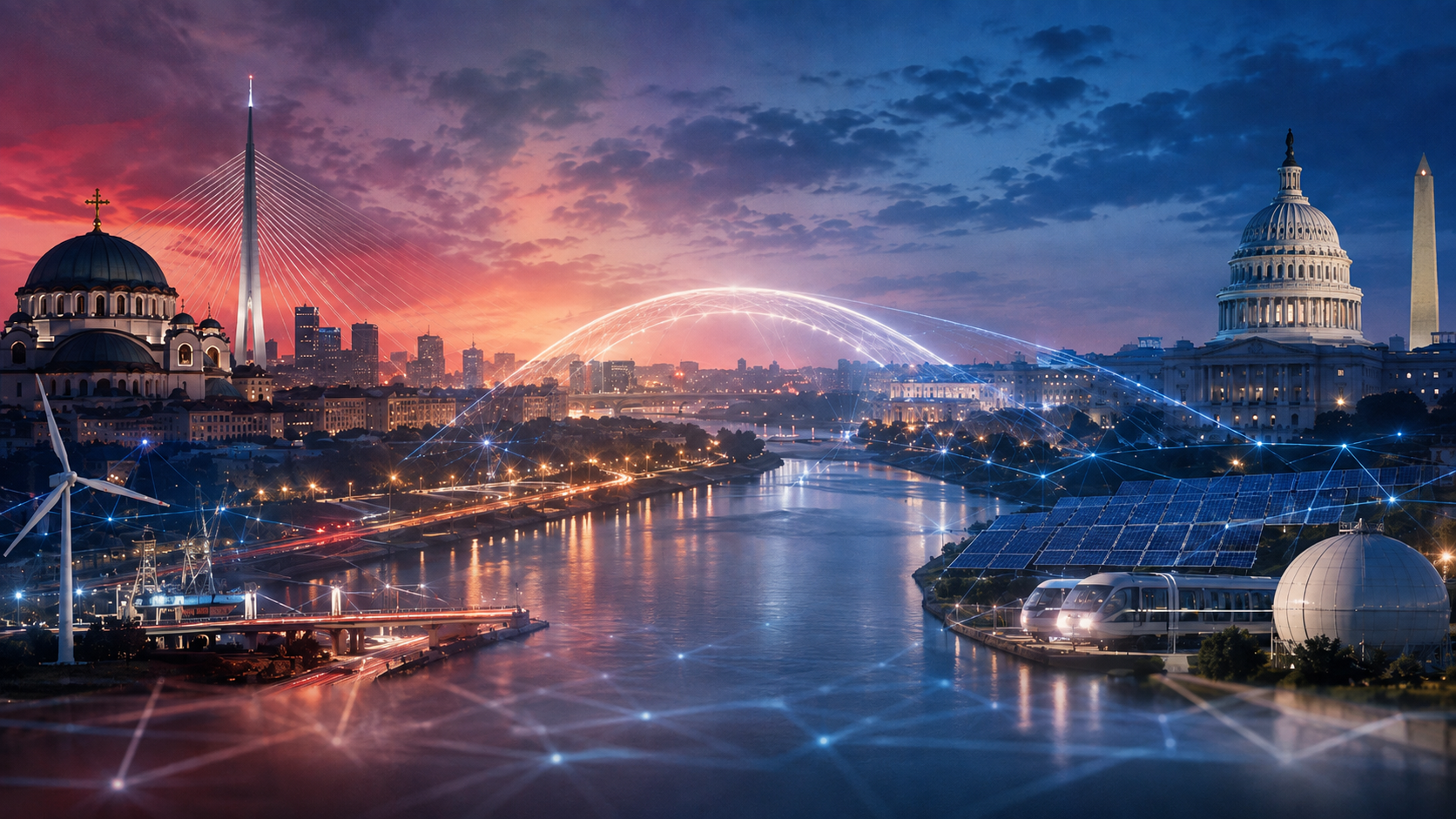
The positive momentum now opening up before us is an opportunity that could create a historic turning point in the country’s position. At that turning point, when it is entirely clear that Serbia is no longer alone, America can become its strongest source of support.
Let us recall the words of the renowned diplomat and former Secretary of State Henry Kissinger, who stressed that a prerequisite for stability in the world is the ability of the greatest powers, at critical moments, to recognize and respect smaller states and regional leaders.
Decades ago, he recognized that global stability is impossible without respect for states that serve as a natural bridge between East and West. Serbia and the United States are today witnessing precisely such a historic moment. Serbia, too, can be that natural bridge between East and West.
To remain grounded in realpolitik, just as French President Charles de Gaulle and British Prime Minister Winston Churchill did when they said, “States have no friends, only interests,” we must also speak about America’s interests.
Washington has interests of its own in creating this geopolitical anchor in the Western Balkans. U.S. strategy calls for reducing the influence of other global powers in the region, above all China and Russia.
If dynamic business activity and economic opportunities are joined by another important component – a shared Christian identity and the values strongly promoted by the current Trump administration in American public life – relations between Belgrade and Washington acquire their full value-based and civilizational dimension. U.S. President Donald Trump recently said: “Christians are a force; Christians are the moral compass and the soul of our society. Let us stop the persecution of Christians.”
Since former United States President Jimmy Carter’s visit to Belgrade in 1980 – the last official visit by a U.S. president to our capital – relations between Washington and Belgrade have passed through decades of estrangement, sanctions in the 1990s, the war during the 1999 NATO aggression, and the crisis over the status of so-called Kosovo, including U.S. recognition of its self-proclaimed independence. During that period, there were individual important events, such as the 2001 visits of Federal Republic of Yugoslavia President Vojislav Koštunica and Serbian Prime Minister Zoran Đinđić to U.S. President Bush, U.S. Secretary of State Colin Powell’s visit to Belgrade in 2003, U.S. Vice President Joseph Biden’s visits in 2009 and 2016, and the signing of the Washington Agreement in 2020. Nevertheless, these events did not amount to systematic and institutional cooperation. Today, following the official signing of the Strategic Dialogue, relations between Belgrade and Washington have reached a new positive peak – a quantum leap and historic shift – and have acquired the institutional form of a partnership.
Before turning to what the dialogue specifically provides for and what it will actually deliver, let us recall the words of the renowned diplomat and former Secretary of State Henry Kissinger, who stressed that a prerequisite for stability in the world is the ability of the greatest powers, at critical moments, to recognize and respect smaller states and regional leaders. Decades ago, he recognized that global stability is impossible without respect for states that serve as a natural bridge between East and West. Serbia and the United States are today witnessing precisely such a historic moment, because our country can serve as a natural bridge between East and West. In a deeply divided world, Belgrade’s ability to speak with everyone is its greatest diplomatic strength, not a weakness.
Falling Tariff Barriers and the Race for Competitiveness
Washington’s decision to launch the Strategic Dialogue was accompanied by the removal of the 35 percent tariff imposed on Serbia during Trump’s tenure. The Supreme Court ruled to abolish U.S. tariffs for all countries, but the subsequent decision by President Trump to reimpose tariffs on 60 countries was encouraging and friendly toward Belgrade. Serbia remained one of the few countries on which no new tariffs were imposed, so a tariff-free regime is currently in force between Belgrade and Washington – something that has never happened in the nearly century-and-a-half-long diplomatic history of the two countries. It is evident that the U.S. side has left the issue of tariffs on Serbia for the continuation of the Strategic Dialogue, while Serbian President Vučić has stated that he expects them to be set at 10 to 12 percent, thereby indicating the level with which Belgrade would be satisfied.
The level of U.S. tariffs, particularly on steel, aluminum, copper and vehicles, is highly important for the Serbian economy and for Serbia’s competitiveness in attracting foreign direct investment, which is crucial to Serbia’s GDP growth. The basic tariffs, together with additional duties on the trade surplus introduced by President Trump, constituted a serious barrier for domestic and foreign companies in Serbia. It can therefore be expected that the level of tariffs and the removal of duties related to the surplus between the United States and Serbia will be Belgrade’s most important topic in the continuation of the Strategic Dialogue, because abolishing these charges and lowering tariffs would bring three key benefits to the Serbian economy.
First, Serbia’s defense, metal and automotive industries gain full price competitiveness on the U.S. market. Second, Serbia becomes significantly more attractive to new foreign investors seeking tariff-free access to the United States. Third, capital previously spent on duties is freed up, directly strengthening the budget and encouraging renewed economic growth. Through this significant gesture, the U.S. administration has demonstrated a willingness to remove trade barriers through diplomatic negotiations and the Strategic Dialogue with Belgrade, giving the partnership with Serbia a new dimension.
Regular Visits by Serbian Delegations to the State Department
The technical side of the Strategic Dialogue – the highest-level institutional mechanism used by the United States in relations with its most important partners – entails regular visits by Serbian delegations to the State Department, the establishment of permanent working groups, and regular ministerial meetings at which policies in several vital areas are directly coordinated.
First and foremost, it includes deep cooperation in the energy sector. It should be recalled that Serbia and the United States signed a strategic energy agreement in September 2024, under which they are working on joint projects involving diversification of energy sources, renewable energy and the construction of critical infrastructure. A second important dimension is security and military cooperation, which provides for the continuation of the partnership with the Ohio National Guard and will now be expanded by the U.S. announcement that it is prepared to sell weapons to Serbia. The Serbian Armed Forces – the strongest in the region, a fact of considerable importance to the U.S. decision on military cooperation – mainly possess modernized Soviet weapons dating from the Yugoslav era, domestically produced weapons, and newer Chinese and Israeli systems. Following Serbia’s purchase of French Rafale aircraft and the intensive military cooperation between Belgrade and Paris, Washington recognized an opportunity for the United States. The announcement that the United States will sell weapons to Serbia is therefore highly significant, because it means that Washington now treats Belgrade as a military ally. This cooperation will increase the share of “Western weapons” in the Serbian Armed Forces’ arsenal, thereby improving the compatibility of the Serbian Armed Forces with NATO, to which the Alliance attaches great importance. NATO considers that the admission of Ukraine and Serbia to the military alliance would strengthen the organization. As Ukraine may remain outside NATO because of Russia, Serbia’s importance is increasing. The announcement means that Serbia has credibility in Washington, because the United States no longer fears that weapons sold to Serbia might fall into enemy hands. The United States has decided to take advantage of Russia’s loss of its positions in Serbia’s energy and defense sectors, in which it traditionally held a monopoly. Washington’s clear intention is to take over Russia’s positions in these sectors in Serbia and prevent Beijing and Tel Aviv from doing so.
The Strategic Dialogue also includes joint activities by Belgrade and Washington in cybersecurity and civil protection, while opening the door to technological and scientific exchange, including higher education, artificial intelligence, and even partnerships in the defense industry and space programs. Of particular importance to young people and scientists in Serbia is the dialogue’s provision for expanded academic exchanges, direct scholarships for Serbian students and researchers at the most prestigious U.S. universities, and joint scientific projects that give our young talents access to the world’s most advanced laboratories and technologies.
Serbia at the Negotiating Table, Not on in
Politically, raising Belgrade-Washington relations to the level of a Strategic Dialogue sends the message that the United States no longer views the Western Balkans exclusively through the prism of unresolved Kosovo issues, but through that of economic and energy stability, which Serbia underpins. The regional significance of the Belgrade-Washington Strategic Dialogue is evident in the considerable concern with which Albanian analysts in Pristina view the move, since it points to a shift in the center of gravity of U.S. policy and reduced support for Pristina’s political elites. For the dialogue on Kosovo and Metohija itself, this means a change in the negotiating position. The strengthening of economic, energy and security ties with America compels all actors to understand that a lasting solution for the region cannot be sought without taking Serbia’s interests into account and treating Serbia with due respect. Put simply, Serbia will be at the table, rather than on the table, as it had been since 1998 and the Rambouillet negotiations. Every few months, officials from Belgrade will be in Washington for targeted, thematic, high-level meetings.
MN: Washington’s Calculus
To remain grounded in realpolitik, just as French President Charles de Gaulle and British Prime Minister Winston Churchill did when they said, “States have no friends, only interests,” we must try to understand America’s interests. Washington defined its interest in this part of the world in the U.S. Congressional Report on United States Policy for Promoting Regional Stability and Prosperity in the Western Balkans, published in May. This document clearly placed Serbia at the center of the new U.S. strategy in the region, announcing a formal Strategic Dialogue in 2026 and stronger economic, energy and security cooperation. After the report’s adoption, it became clear that Washington now sees Belgrade as its key bilateral partner in the region, through an approach that differs significantly from previous decades and focuses on business, investment and geopolitical competition with Russia and China.
When Washington decided to align its policy with economic interests, Serbia acquired the greatest importance because it is the region’s strongest economy. Projects in Serbia currently being negotiated by Belgrade and Washington are worth between EUR 3.6 billion and EUR 4.3 billion. The scale of this progress is illustrated by the fact that, according to official data from the U.S. Embassy in Belgrade, the total value of U.S. investment in Serbia from 2000 to 2023 was approximately USD 4 billion. Over the same period, the United States invested approximately EUR 1.5 billion in so-called Kosovo over 25 years, while new U.S. investment in Pristina is currently only around EUR 10 million annually.
What matters far more to the United States is the amount invested in Serbia by the People’s Republic of China. This is evident from the fact that the two current projects under negotiation between Belgrade and Washington are worth almost one quarter of the total value of all Chinese projects implemented in Serbia over the past two decades. If total Chinese investment in Serbia, including giants such as Zijin and HBIS, amounts to approximately EUR 22 billion over 25 years, while ongoing infrastructure contracts involving Chinese companies are estimated at around EUR 9.5 billion, then the surge in U.S. economic engagement in Serbia through new investment carries historic weight. Considering the announcements of future cooperation in nuclear energy and liquefied natural gas infrastructure, it is entirely clear that Washington is entering a competition with Beijing for economic primacy in Serbia, fully in line with the U.S. Congress’s strategy of actively competing for influence in the Western Balkans. Official confirmation of U.S. participation in the specialized exhibition in Belgrade also sends a message of support for economic stability and infrastructure projects in the region.
Shared Values and the Spiritual Dimension
President Trump’s new term in the White House has unexpectedly presented Belgrade with an opportunity to improve and consolidate relations with Washington through a shared Christian identity and the values that the current Trump administration strongly promotes in American public life. In this way, relations between Belgrade and Washington acquire their full value-based and civilizational dimension. U.S. President Donald Trump recently said: “Christians are a force; Christians are the moral compass and the soul of our society. Let us stop the persecution of Christians. America will no longer turn a blind eye to the persecution of Christians and believers, whether in our own country or anywhere in the world. We will stand firmly with those who preserve their faith and tradition.” It is precisely this Christian orientation of the U.S. president and the country he leads that represents an unexpected opportunity for Serbia – one that was missed in 2004, when Kosovo Albanians burned and destroyed 35 churches during the March pogrom against Serbs, including 18 cultural monuments, among them the Church of Our Lady of Ljeviš in Prizren. Although Serbia’s diplomacy at the time – namely Foreign Minister Vuk Jeremić – advised Serbian Prime Minister Vojislav Koštunica that Belgrade should launch a diplomatic offensive in Washington and that he should personally appeal to President Bush over the destruction of Christian churches, this did not happen because Belgrade was frustrated by the U.S. position regarding the forthcoming self-proclamation of the independence of Kosovo and Metohija. Serbia had to wait almost two decades for a new opportunity. In the meantime, the authorities in Zagreb, Podgorica, Pristina, Sarajevo and Tirana conducted a powerful, well-funded and carefully designed lobbying campaign in which the Serbian Orthodox Church was portrayed to the U.S. administration as “an outpost not of the Russian Orthodox Church, but of the Russian security services in the Balkans” and as “a paramilitary organization serving as the advance guard of the Serbian and Russian armies.” The architects of this campaign, playing the “Russian card,” believed that they would prompt the United States to act against the Serbian Church, especially after the outbreak of the war in Ukraine. For the architects of this campaign, Russia was the narrative intended for Washington. They understood that the Serbian Orthodox Church is the principal integrating factor of the Serbian people in the Balkans, regardless of the state in which they live. To achieve their national objectives, assimilate the Serbian population and complete the process of constructing their nations, they needed the Serbian Church to be broken up and returned to the situation before 1920, when all Serbian Orthodox dioceses united in a single Church. The campaign gained particular momentum after President Trump’s defeat in the 2020 election, the hollowing out of the Washington Agreement, and the return to the State Department of officials who had participated in the creation of an independent Kosovo and the bombing of Serbia. A plan also discussed in Washington envisaged separating the Patriarchate of Peć, which would encompass the Serbian dioceses in Kosovo and Metohija and Montenegro and would at some point be recognized by the Ecumenical Patriarchate following the model of the Church in Ukraine. Independent Orthodox churches would then be created in Croatia and Bosnia and Herzegovina; over time, they would no longer be exclusively Serbian, but would become religious homes “for Orthodox Croats” and “Orthodox Bosniaks.” Implementation of this strategy began in Montenegro with the adoption of a law under which property was taken from the Serbian Orthodox Church. The timing was poor because it occurred in an election year. The Church responded with religious processions and mass gatherings, while the Montenegrin government of the time underestimated the significance and role of the Church in Montenegro. The sheer number of Church supporters surprised everyone and led to a change of government in Podgorica. The failure of the plan at its first step was seized upon by experienced diplomat Christopher Hill, whom U.S. President Biden personally brought out of retirement and sent to Belgrade with a mandate to improve U.S.-Serbian relations. Ambassador Hill, who had extensive experience in the Balkans dating from the 1990s, believed that if his country wanted peace in the Balkans, it needed close relations with Serbia. Because he had been appointed by President Biden, Hill, following the example of his former superior Holbrooke, was able to bypass the State Department and completely dismantle the plan to divide the Serbian Church. Hill believed that the Serbian Church, which has a strong and extensive presence in the United States, could serve as a bridge of cooperation between the two countries rather than as a problem. Ambassador Hill therefore deserves the greatest credit for the change in the U.S. position. The Serbian Church accepted dialogue after U.S. Ambassador Christopher Hill reacted sharply in December 2022 to the Pristina authorities’ decision to ban the Patriarch from entering Kosovo, stressing that this was a fundamental issue of religious freedom. This opened a permanent and direct channel of dialogue between the Patriarchate and the U.S. Embassy, and later Washington itself, leading two years later, in April 2024, to a visit by U.S. Assistant Secretary of State for European and Eurasian Affairs James O’Brien to Serbian Patriarch Porfirije in Belgrade. In April of this year, Serbian Patriarch Porfirije received Paolo Zampolli, the U.S. Special Representative for Global Partnerships, with whom he discussed improving cooperation between the two peoples. The recent visit by Mark Burns, spiritual adviser to U.S. President Trump, who accompanied Patriarch Porfirije to Kosovo and Metohija, attended the Divine Liturgy at the Patriarchate of Peć and then visited Visoki Dečani and other Serbian Orthodox holy sites, shows that the Serbian Church and Christianity have acquired an important role in Serbian-American relations, and that Belgrade has gained a diplomatic asset that could prove particularly important in addressing relations with Pristina and Sarajevo.
In conclusion, decision-makers and political elites should bear in mind that the greatest value in politics and diplomacy lies in the ability to recognize momentum. The positive momentum now opening up before us is an opportunity that could create a historic turning point in the country’s position. At that turning point, when it is entirely clear that Serbia is no longer alone, America can become its strongest source of support.
Autor teksta: IPESE Research Team


