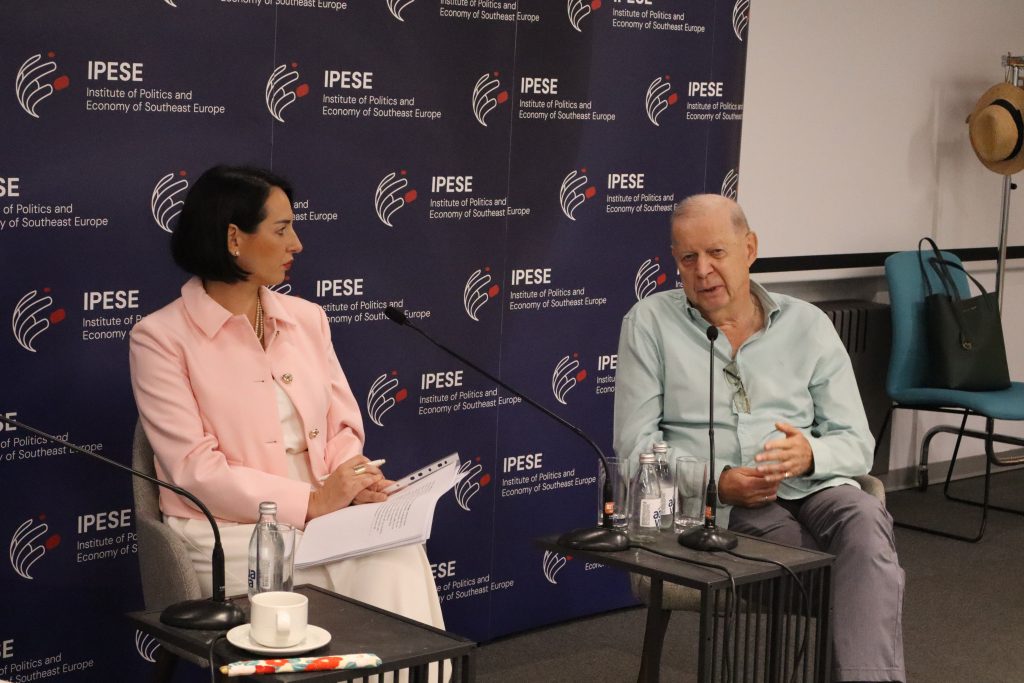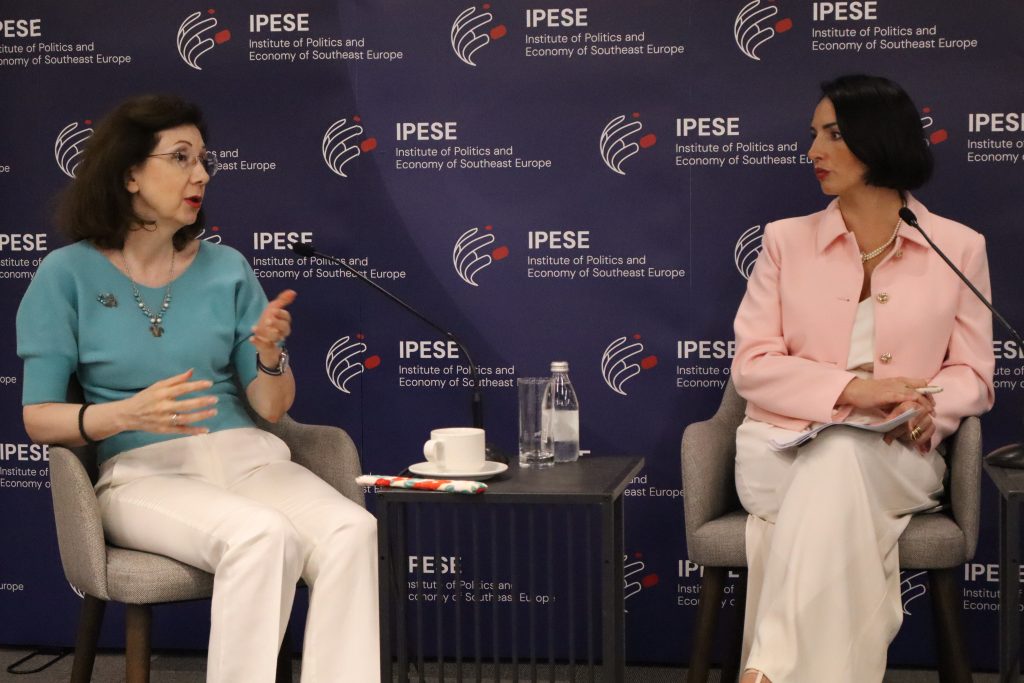
The Institute for Politics and Economy of Southeastern Europe (IPESE) organized the panel discussion “Belgrade 1961–2026: The Legacy of the Non-Aligned Movement in a World of New Divisions”, marking the 65th anniversary of the First Conference of the Non-Aligned Movement in Belgrade and examining the relevance of the principles of non-alignment in contemporary international relations.
The panel featured diplomat Zoran Milivojević and Prof. Dr. Dragana Mitrović of the Faculty of Political Sciences, University of Belgrade, who discussed the historical role of the Non-Aligned Movement, its position in today’s international order, and its significance for Serbia’s foreign policy interests.
Milivojević emphasized that, since its establishment, the Non-Aligned Movement has represented an authentic response by states unwilling to accept the logic of a world divided into opposing blocs. According to him, the principles of freedom, equality, independence, respect for international law, sovereignty and territorial integrity, as well as active commitment to peace and cooperation, remain relevant more than six decades after the Belgrade Conference.
“The Non-Aligned Movement could not be ignored on the global stage after 1961,” Milivojević stressed, recalling that during the Cold War the major powers sought to draw the Movement closer to their own political and strategic interests, while its independence was nevertheless preserved.
Speaking about the contemporary international environment, Milivojević assessed that the principles on which the Movement was founded are once again gaining importance amid wars, new divisions and the strengthening of multipolarity.
“The Movement has an opportunity to develop into a mechanism that could provide a balance to everything we are witnessing today,” Milivojević said, also pointing to the growing importance of the Global South, whose countries possess significant demographic, economic and natural-resource potential.
Prof. Dr. Dragana Mitrović recalled that the Non-Aligned Movement today represents one of the world’s largest groupings of states and that its longevity demonstrates that the ideas on which it was founded have not lost their relevance.
She particularly emphasized the Movement’s efforts to contribute to greater economic equality, a fairer distribution of global wealth, and the preservation of the right of states and peoples to make independent decisions concerning their own development and resources.
Mitrović highlighted the enduring importance of the Bandung Principles, based on the equality of states, non-interference in internal affairs, respect for different historical experiences and cultural heritage, and the right of peoples to political and economic independence.
Speaking about the First Conference of the Non-Aligned Movement, held in Belgrade in 1961, Mitrović recalled the process of decolonization and the struggle of numerous peoples for political independence. In that process, she noted, the Non-Aligned Movement and its founding countries played an exceptionally important role, while Yugoslavia held a particularly significant position.
One of the topics addressed during the panel was the contemporary importance of the Non-Aligned Movement for Serbia, particularly with regard to the issue of Kosovo and Metohija.
Milivojević described the Movement as an important diplomatic and political strategic reserve for Serbia, noting that Belgrade’s arguments rely to a considerable extent on the very principles of sovereignty, territorial integrity and international law that form the foundation of the Non-Aligned Movement.
He recalled that numerous members of the Movement had voted against Kosovo’s membership in international organizations and that countries which had withdrawn their recognition of Kosovo over the previous years also belonged to this group of states.
According to Milivojević, the fact that many members of the Movement have had their own experiences with separatist movements further contributes to their understanding of Serbia’s position.
Discussing why Belgrade became the venue for the first summit of the Non-Aligned Movement in 1961, Milivojević assessed that Yugoslavia’s selection was no coincidence. Yugoslavia was a socialist but European state that did not wish to align itself with either of the blocs of the time, while simultaneously supporting the aspirations of newly independent states and possessing the political and organizational capacity required to host a gathering of such significance.
The Belgrade Conference thus became one of the key moments in the development of the policy of non-alignment and a symbol of the efforts of a large part of the world to find its own voice outside the bipolar divisions of the era.
Sixty-five years later, the discussion organized by IPESE demonstrated that the issue of non-alignment does not belong solely to history. At a time of renewed geopolitical divisions, wars, growing multipolarity and the increasingly prominent role of the Global South, the principles of international law, sovereignty, equality among states and peaceful cooperation are once again at the center of the debate over the future of the international order.