

The key message of the document can be interpreted as a “green light” for business and stability, as well as the creation of a new era of economic and energy partnerships.
With a population of 18 million, the region lies along major transport corridors, possesses natural resources, a growing technology sector, and a skilled workforce.
The document announces a formal Strategic Dialogue with Serbia in 2026, while the U.S. tone toward our country regarding the Kosovo issue is less confrontational than in the past. This shows that Washington recognizes Belgrade as the most important player in the region.
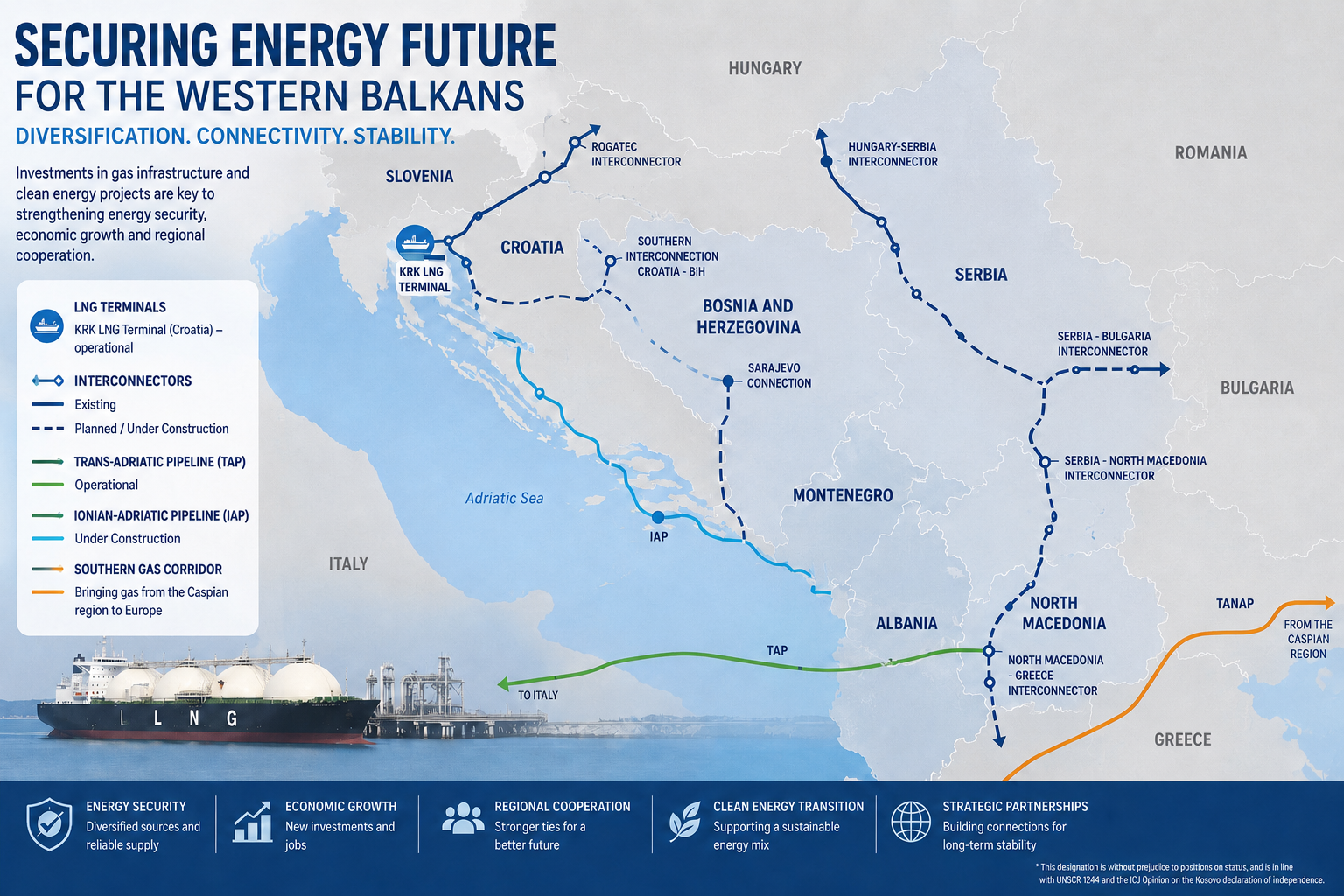
The opportunity lies in U.S. liquefied natural gas (LNG), nuclear technology including small modular reactors, and renewable energy sources. Serbia and Bosnia and Herzegovina have signed a joint statement on investments that can increase Europe’s secure and reliable energy supply.
During the 1990s, the Balkans ranked high on the list of foreign policy priorities of the United States of America.
During those difficult years, Washington and the White House were practically engaged on a daily basis in resolving crises in Southeast Europe and the Western Balkans.
After the end of the wars, but also because of the crisis the United States experienced during and after the terrorist attacks of September 11, 2001, America’s focus shifted drastically and immediately to the Middle East, above all Iraq and Afghanistan, and to the fight against terrorism.
It is widely interpreted that America at that time considered the job in the Balkans to be “finished” and largely handed over permanent care for our region to the European Union.
Circumstances have changed. American interest in the region began to grow again after Russia’s annexation of Crimea in 2014, and especially after Russia’s aggression against Ukraine in 2022, as well as due to the massive penetration of Chinese capital into the Balkans. In strategic circles, it is said that Americans realized that during the years of disengagement they had left a vacuum in the Western Balkans, which Russia and China quickly began to fill.
A CLEAR AND PRAGMATIC AGENDA
The Report to Congress on United States policy to promote regional stability and prosperity in the Western Balkans, published in May 2026, officially and quite precisely presents a new form of American interest in this area, significantly different from previous decades. In the past, the focus was on strengthening democracy and the internal organization of states, while now the focus is on partnership and business. In practical terms, the key message of the document can be interpreted as a “green light” for business and stability, and the creation of a new era of economic and energy partnerships. The catch may be that there is also a “red light” concerning the influence of Russia and China. Gas and energy dependence on Russia is criticized, while China is targeted over non-transparent loans and projects.
The Report to Congress on United States policy to promote regional stability and prosperity in the Western Balkans represents a significant shift in U.S. policy toward the region. The document is not written in the classical style that dominated American foreign policy after the fall of the Berlin Wall, based on the formula of “democratization – reforms – European integration.” Instead, it is framed much more through the lens of security, U.S. economic interests, and geopolitical competition with Russia and China.
STABILITY AND SECURITY AS PRECONDITIONS
The document should first be viewed through the points it highlights. In the first place are the security and stability of the Western Balkans, which are characterized as a priority and an absolute precondition for all other activities. The era of U.S.-led state-building is over. It is made clear that Washington no longer intends to spend resources persuading Balkan peoples how to organize their societies, nor does it wish to play the role of either international judge or savior.
“The Administration is focused on empowering local actors to address their own challenges, rather than prolonging excessive reliance on international intervention or oversight. The United States is prepared to provide support where our engagement is desired and where it advances U.S. interests.”
STRATEGIC DIALOGUE WITH SERBIA IN 2026
The second point is probably where the most constructive and positive part of the agenda can be found.
“The second pillar of the Administration’s policy toward the Western Balkans is competing for U.S. commercial interests in a region that offers economic opportunities. With a population of 18 million, the region lies along major transport corridors, possesses natural resources, a growing technology sector, and a skilled workforce. Market access is a fundamental factor. The Administration is focused on ensuring fair, reciprocal trade and removing barriers for American companies,” the document states.
It has been confirmed that the Office of the United States Trade Representative (USTR) is negotiating reciprocal trade agreements with North Macedonia and Serbia. The document announces a formal Strategic Dialogue with Serbia in 2026. This shows that Washington recognizes Belgrade as the most important player in the region. However, the report also lists possible obstacles. The region suffers from an infrastructure deficit; physical transport networks lag behind European standards, which increases costs for businesses and limits market integration. Digital infrastructure is also a challenge, due to uneven coverage of high-speed broadband internet and insufficient cybersecurity capacity to protect the region’s growing digital networks. Energy infrastructure is also outdated, inefficient, and at times overly dependent on Russian imports. It is emphasized that the United States will seek infrastructure investments in partnership with American companies. Improvement can rely on the Strategic Cooperation Agreement in the Field of Energy between Serbia and the United States of America, signed on September 18, 2024, in Washington. Diversification of energy supply is highlighted as an exceptionally important element. The opportunity lies in U.S. liquefied natural gas (LNG), nuclear technology including small modular reactors, and renewable energy sources. Serbia and Bosnia and Herzegovina have signed a joint statement on investments that can increase Europe’s secure and reliable energy supply. The Report clearly states that the U.S. Department of State will actively engage in turning regional interest into commercial deals.
“Priority projects include the Southern Interconnection gas pipeline between Croatia and Bosnia and Herzegovina, the proposed Serbia–North Macedonia gas interconnector, and the development of hydropower in Albania, Bosnia and Herzegovina, North Macedonia, and Serbia.”
This demonstrates the interest of the American administration and opens the possibility of intensive cooperation with the countries of the Western Balkans, while giving priority to American energy companies. Serbia should treat all these new circumstances as an opportunity, but not only as an economic and business opportunity. It should also view them as a chance to create lasting and secure energy diversification, as opposed to energy dependence on Russia.
Serbia is explicitly listed as an important U.S. partner, and the document states that the United States has robust and positive relations with all Western Balkan countries, “including Serbia.”
The fact that the Report highlights that the U.S. administration plans to hold dialogues with North Macedonia and Serbia during 2026 shows that Washington treats these two countries as bilateral partners and does not view cooperation solely through regional formats. Serbia can be satisfied with the Report to Congress on United States policy to promote regional stability and prosperity in the Western Balkans, because Belgrade is no longer presented as a “problem to be solved,” but as a country with which the United States wants a structured relationship and direct communication.
THE KOSOVO ISSUE REMAINS A U.S. PRIORITY, BUT DOES IT SIGNAL A REPEAT OF THE BOSNIA AND HERZEGOVINA SCENARIO?
The Report to Congress on United States policy to promote regional stability and prosperity in the Western Balkans shows that Kosovo remains the central political issue in the region, but Washington’s approach is now different. The document states that “the United States continues to encourage Serbia and Kosovo to make progress in normalizing relations with the goal of a lasting agreement acceptable to both sides.”
It is impossible not to notice that the Report does not demand Serbia’s formal recognition of Kosovo as an independent state, nor an urgent agreement on this issue, nor does it threaten Serbia with consequences if it fails to take steps in that direction. Earlier formulations of U.S. policy regarding Kosovo were much tougher. The current wording refers to a negotiated agreement, a lasting solution acceptable to both sides. This may indicate a future, more flexible U.S. approach to this issue, one that takes Serbia’s interests more into account, in a manner similar to the way Washington established a partnership with Banja Luka, that is, with Republika Srpska in Bosnia and Herzegovina.
The Report to Congress on United States policy to promote regional stability and prosperity in the Western Balkans envisages the expansion of military cooperation with Serbia. “The Administration will continue to expand security and defense cooperation with Serbia in ways that advance U.S. interests,” the document states. For Serbia, this message is very important because Belgrade is not a NATO member. The document does not speak of “pressuring Serbia to join NATO,” but rather of joint military programs, military personnel training, military cooperation, and security projects.
CHALLENGES AND INFLUENCES FROM THE EAST
The document states that, in addition to Russia, China is also expanding its influence through soft power, and that Beijing uses trade, state loans, propaganda, and partnerships to increase its influence. The Report openly attacks the Chinese investment model in Serbia and announces that the United States is prepared to adopt this model in order to counter China in Serbia. The document states that “China uses trade, state loans, bribes, propaganda, and partnerships with elites to increase influence,” as well as that “Chinese companies often offer lower prices, while cost overruns and delays appear later.”
This part of the Report is particularly significant for Serbia, where China has been present in recent decades through the construction of infrastructure projects as well as investments in the economy. It is clear that the United States is trying to offer an alternative to Chinese investments. In this regard, the document also indirectly touches upon the issue of Serbia’s international agreements, as it states that “intergovernmental agreements allow American companies to compete more effectively for strategic projects.” In this way, unlike the European Union, the United States does not criticize intergovernmental agreements and special laws, known as lex specialis. Washington practically accepts the model in which major projects are implemented through intergovernmental arrangements, a model Serbia already uses with China, the Russian Federation, France, the United Arab Emirates, Turkey, Egypt, and Hungary.
When it comes to the security sector and the fight against crime, the Report emphasizes that America aims to actively work on suppressing drug cartels originating from the Western Balkans.
The key message of the Report can be summarized as follows: “The Administration directs resources toward activities that produce clear, visible benefits for U.S. interests, prioritizing short-term, measurable results over open-ended institution-building. Commercial engagement programs will emphasize deal facilitation, market access, and investment climate reforms — activities with a direct return for American companies.”
CONCLUSION
The Report to Congress on United States policy to promote regional stability and prosperity in the Western Balkans shows that U.S. policy toward the region, and toward Serbia as well, is no longer predominantly based on pressure over political issues. Instead, it is based on an attempt to attract Serbia through security, energy, trade, and infrastructure projects, while at the same time reducing Russian and Chinese influence. The United States has decided to compete with Russia and China for Serbia.
The three key messages for Serbia from the Report to Congress on United States policy to promote regional stability and prosperity in the Western Balkans are:
- Serbia is becoming an important geopolitical bilateral partner of the United States, one that Washington aims to draw away from China and Russia;
- Kosovo remains an open issue, but the tone is less confrontational, with an emphasis on dialogue that should be satisfactory to both sides;
- The U.S. focus is no longer on politics, democratic freedoms, and human rights, but on the economy, energy, and security.
Autor teksta: IPESE Research Team


